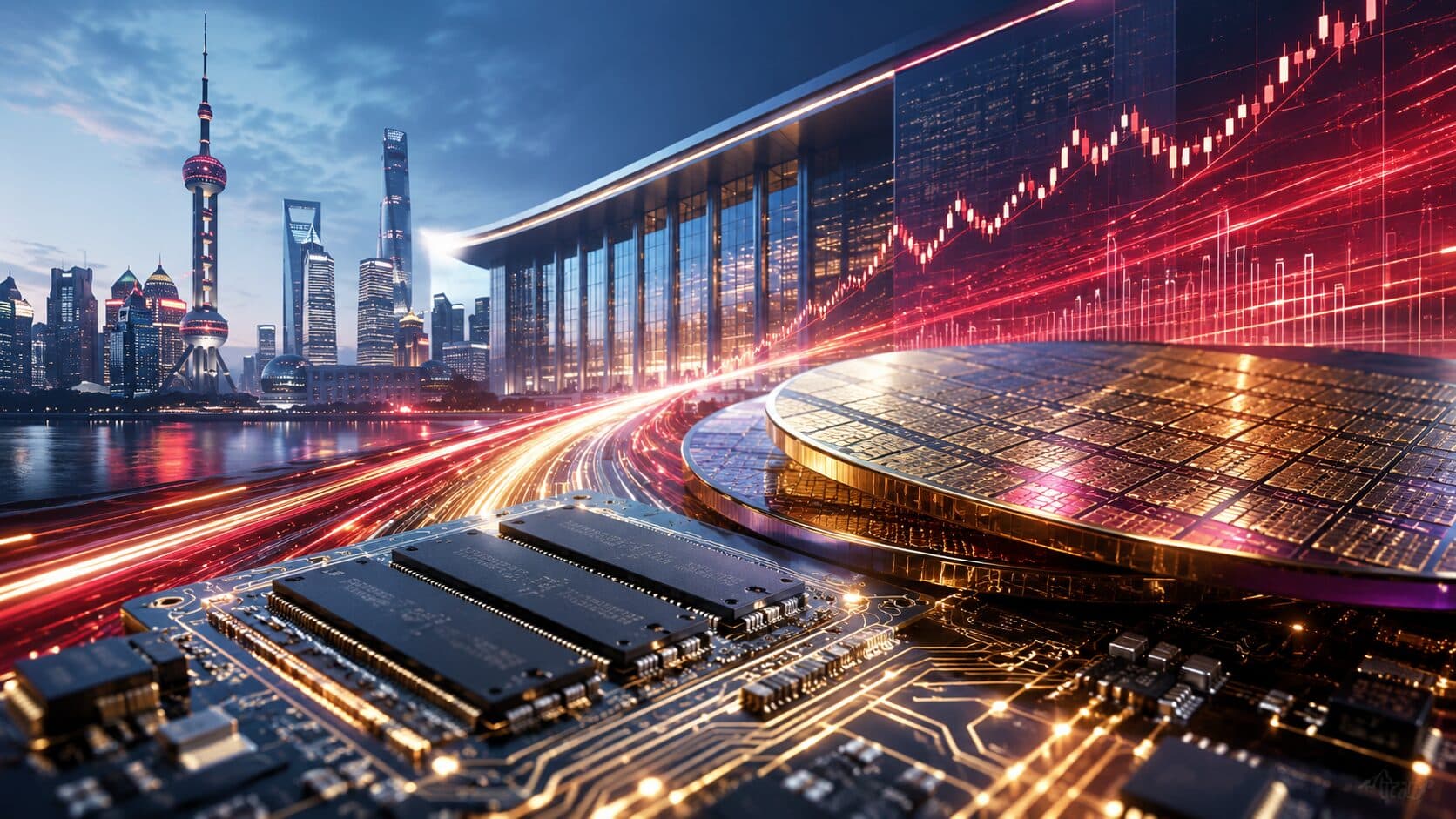
Taiwan Semiconductor Manufacturing Co. delivered almost everything an AI infrastructure bull could have wanted from its second-quarter earnings report.
Revenue reached $40.2 billion, an increase of 33.7% from a year earlier. TSMC recorded another quarter of record profit. Gross margin reached 67.7%, operating margin came in at 60.3%, and management raised its expectations for full-year growth. The company increased its 2026 capital-spending forecast to between $60 billion and $64 billion, up from the $52 billion to $56 billion range it offered at the beginning of the year. It also indicated that investment over the next three years would be significantly higher than during the previous three.
If anyone was still waiting for evidence that demand for advanced silicon is real, TSMC supplied it.
Then the chip stocks fell.
TSMC declined. NVIDIA declined. Arm, Micron and Marvell were among the other semiconductor names caught in the selling. The broader chip sector had already been under pressure from profit-taking, increasingly leveraged AI trades, competition from Chinese technology companies and questions about whether the industry’s enormous capital expenditures would produce equally enormous returns. One earnings announcement did not cause all of it, and one day of trading does not settle the future of an industry.
But the market’s reaction was still telling. TSMC delivered record results, confirmed extraordinary demand and promised to build considerably more capacity. Investors did not hear only the demand story. They also heard the spending story.
Those are not necessarily the same story.
The Federal Reserve of AI
Gennaro Cuofano captured the bull case particularly well in an essay titled “The Foundry Is the New Federal Reserve of AI.”
Cuofano argues that TSMC’s quarterly earnings call has become the closest thing the AI economy has to a Federal Reserve meeting. The financial results describe current conditions, but the company’s capital spending, technology roadmap and wafer-allocation decisions tell the industry how much advanced compute it will receive, when it will become available and, to some extent, who will receive it.
The Federal Reserve influences the price and availability of money. TSMC increasingly influences the price and availability of advanced compute. Its vocabulary is composed of wafers, yields, nodes and packaging rather than interest rates, reserves and basis points, but Cuofano believes the economic function is becoming similar.
It is a powerful metaphor because it contains a great deal of truth.
Leading-edge semiconductor manufacturing is not presently a commodity. Customers cannot casually move their most advanced designs to another foundry and expect the same yields, performance, capacity or production schedule. TSMC’s engineering expertise, manufacturing discipline and decades of investment have created a position that competitors have spent billions attempting to reproduce.
The company’s margins tell the story. A business producing a 67.7% gross margin and a 60.3% operating margin is not struggling to distinguish itself in a market filled with interchangeable suppliers. TSMC has real pricing power because its manufacturing capabilities remain scarce, difficult to replicate and indispensable to many of the world’s most important technology companies.
Cuofano is not some wild-eyed promoter pretending that every AI investment will produce instant riches. He understands the physical constraints of this industry better than most. He sees the shortage of advanced chips, packaging, memory, energy and manufacturing capacity. He recognizes that software may scale rapidly, but the factories supporting it cannot be created with another download or an overnight code deployment.
I cite Cuofano in the final chapter of my forthcoming book as a classic AI bull, and I mean that respectfully. He makes the intelligent version of the bull case. The AI economy, in his view, is not being recklessly overbuilt. It remains dramatically underbuilt.
He may be right.
That does not mean the companies financing the buildout cannot become dangerously overinvested.
Demand is Not the Same as Returns
This distinction sits at the center of the AI infrastructure debate:
Being underbuilt does not mean being underinvested.
The world may consume every advanced processor, server rack, data center and available gigawatt the industry can bring online. Demand for AI compute may grow for years, perhaps decades. That still does not guarantee that every company supplying the infrastructure will maintain today’s margins or earn an attractive return on every incremental dollar it invests.
The AI infrastructure bulls may win the argument over demand and still lose the investment thesis.
We have seen this movie before.
The railroad bulls were correct that a rapidly industrializing United States required many more miles of track. Railroads became essential to the movement of people, food, raw materials and finished goods. Traffic increased, the national economy expanded and rail transportation became indispensable.
That did not prevent overbuilding, ruinous competition, bankruptcies and consolidation. The country needed railroads. It did not need every railroad company that attracted capital during the boom, nor did rising freight demand protect every investor from the economic consequences of competing routes and excess capacity.
The electricity bulls were also right. Power consumption grew as factories, businesses and homes electrified. Electricity became the foundation beneath virtually every other modern industry. Yet its indispensability did not turn every power producer into an infinitely profitable enterprise. Generation expanded, distribution became standardized, regulation increased and electricity became something customers purchased primarily by volume and price.
Then came fiber.
The telecom bulls correctly anticipated that internet traffic would explode. If anything, many of their traffic forecasts proved too conservative. But the huge demand projections attracted huge amounts of capital. Companies laid enormous quantities of fiber, often financed by debt and valuations that assumed bandwidth scarcity would persist.
The traffic arrived. So did the capacity. Bandwidth prices collapsed, providers failed and the infrastructure changed hands for fractions of what it cost to build. The internet did not disappoint. The economics of supplying it did.
This is the mistake infrastructure bulls make repeatedly. They assume that increasing consumption protects the scarcity value of the underlying resource. In reality, visible demand attracts capital, capacity and competition. The more certain the growth appears, the more aggressively the market attempts to supply it.
The bulls may be right about how much infrastructure AI will consume and wrong about almost everything that follows from it. Demand does not prevent commoditization. It attracts the capital that causes it.
Building Away the Scarcity
TSMC is not about to become a commodity foundry. Its technology leadership is real, and the capability gap separating it from much of the market cannot be erased merely by announcing another government subsidy or construction project.
But the direction of travel matters.
Every new TSMC fab addresses part of the shortage supporting TSMC’s current power. Samsung is also investing. Intel continues pursuing its foundry ambitions. Governments are pouring public money into domestic semiconductor capacity. Advanced packaging production is expanding. Memory manufacturers are racing to supply more high-bandwidth memory. Hyperscalers and frontier AI companies are developing custom silicon designed for narrower and increasingly specific workloads.
No single one of those developments makes TSMC interchangeable. Collectively, however, they increase supply, create alternatives and apply pressure to the scarcity economics on which today’s extraordinary returns depend.
Even TSMC’s own success contributes to the process.
Cuofano sees the company’s rising capital expenditure as evidence that the AI buildout has much further to run. I see that too. Where we differ is what happens when the building succeeds.
TSMC must spend tens of billions of dollars to remain TSMC. Each new process node requires another enormous commitment to research, equipment, construction and production. Fabs take years to plan and build, and once that concrete is poured, the investment cannot be recalled because market conditions changed. Manufacturing equipment begins depreciating whether customer demand meets the most optimistic forecast or falls slightly short.
The company also bears risks that many of those above it do not. It must manage construction, yields, materials, water, power, labor and geopolitics. It must expand internationally while attempting to preserve the operational excellence developed in Taiwan. It must make decisions today about demand that may not fully materialize until 2028 or later.
TSMC’s customers have options, even if those options remain imperfect. They can redesign chips, change architectures, shift workloads, build custom processors, optimize models or pursue other suppliers. TSMC cannot decide that manufacturing has become too capital-intensive and simply move up the stack without jeopardizing the position it has spent decades building.
Everyone depends on TSMC. TSMC, in turn, must keep rebuilding itself so everyone can continue depending on it.
That is the paradox of indispensability.
The Trap Beneath the Boom
The indispensability trap does not say that infrastructure is unimportant or unprofitable. It says that becoming essential to the operation of the economy does not guarantee permanent control over the value that economy creates.
Infrastructure providers make the layers above them possible. Their success encourages investment, standardization and competition. Over time, those forces make the infrastructure more abundant, comparable and interchangeable. Value then migrates toward the companies owning the applications, customer relationships, proprietary data and other differentiated layers built on top.
TSMC may resist that process longer than almost anyone because its manufacturing expertise is so difficult to duplicate. It may remain the world’s leading foundry and a highly profitable company for many years.
But the relevant question is not whether TSMC will remain profitable. It is whether the next $60 billion of investment will produce returns comparable to the last $60 billion—and whether the industry’s collective investment will preserve or gradually compress the economics of producing AI compute.
That is what investors appeared to be asking when semiconductor shares fell despite TSMC’s extraordinary results. They were not necessarily questioning whether the AI economy needs more chips. They were questioning what it will cost to supply them and who will retain pricing power once the capacity arrives.
One trading session is a signal, not a verdict. The chip selloff also reflected concerns about lower-cost Chinese AI, crowded technology trades and the sustainability of the broader AI rally. But those issues lead back to the same question. If models become cheaper, more efficient and more plentiful while infrastructure capacity expands, how long can every part of the current stack preserve scarcity-level margins?
Cuofano believes the enormous demand for AI infrastructure validates the continuing buildout. I believe the continuing buildout is what will eventually undermine its economics.
TSMC may indeed be the Federal Reserve of AI today. But central banks preserve their influence by controlling the supply of money. TSMC’s commercial mission requires it to do the opposite: Build more fabs, produce more wafers, expand packaging and satisfy as much demand as its factories can support.
That makes TSMC powerful. It makes TSMC essential. It also requires TSMC to finance the expansion that gradually reduces the scarcity behind that power.
The AI economy remains underbuilt. The infrastructure industry can still become overinvested. Both things can be true, and the distance between them is where the next version of the indispensability trap is already taking shape.