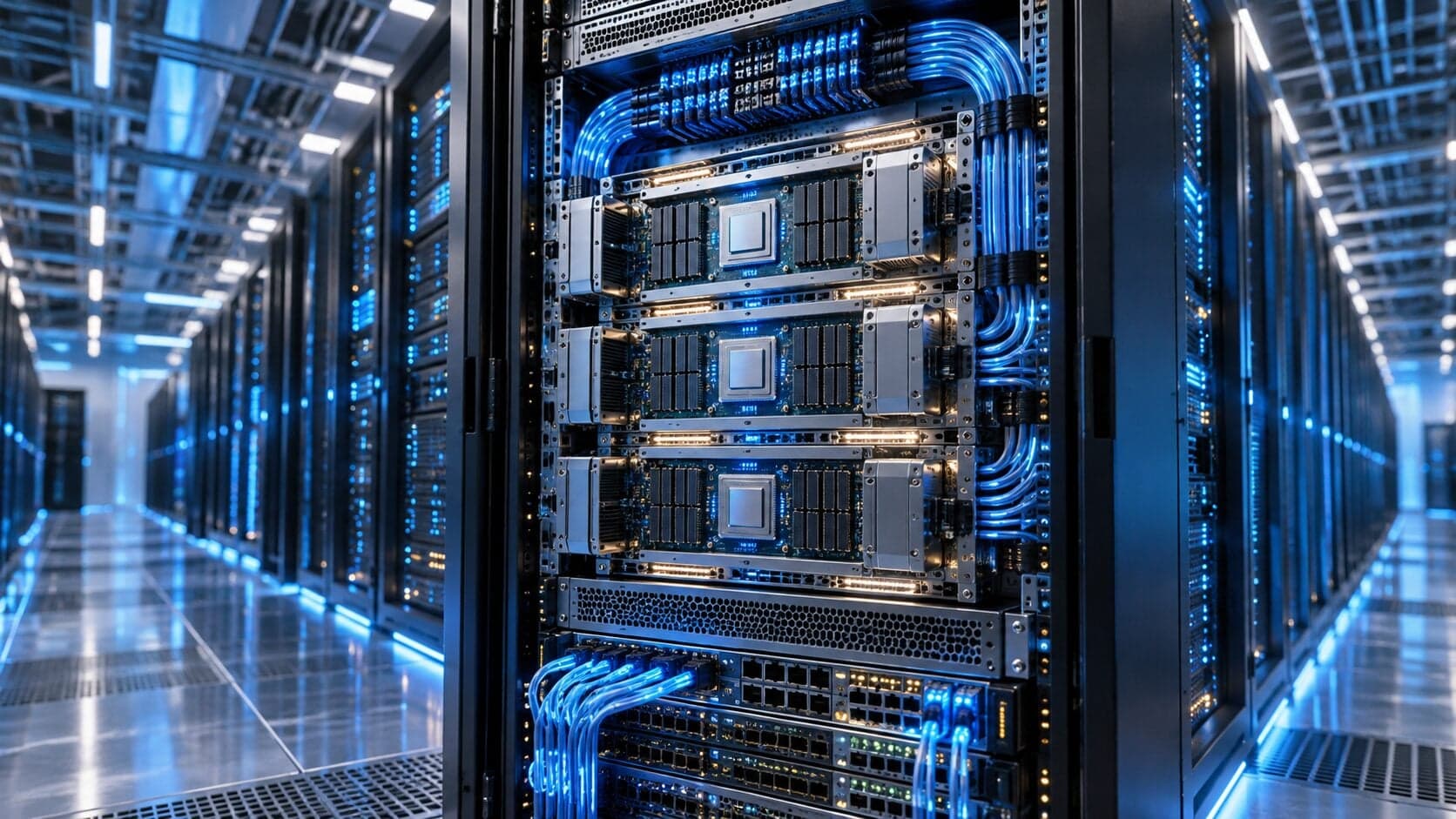
Chinese supercomputer manufacturer Sugon Information Industry has launched a massive AI supercluster powered by more than 100,000 domestically developed computing cards, a major advance in China’s effort to build its own high-performance computing infrastructure.
The system, called Sugon 8000 or Dawning 8000, is operating in Zhengzhou, Henan province. The supercluster is a major step up from China’s previous generation of domestic 10,000-card computing systems. Its architecture combines traditional supercomputing capabilities with AI processing, enabling the same infrastructure to support scientific simulations, LLM training and AI inference.
This combination matters because scientific computing and AI workloads place different demands on processors and networking. Sugon’s architecture is designed to distribute computing resources across these tasks, allowing companies to use the infrastructure for a broad range of use cases.
The system’s launch also demonstrates China’s progress in developing advanced computing infrastructure using domestically developed AI chips. Sugon, which originated as a spinoff of the Chinese Academy of Sciences, has developed supercomputing technology for more than three decades.
But building a supercluster of this size requires considerably more than producing processors. A system with 100,000 interconnected computing cards needs sophisticated networking, high-capacity storage, liquid cooling and software capable of managing workloads across thousands of processors. These requirements create major engineering challenges, particularly when the hardware and supporting technologies are developed domestically. Sugon says the supercluster uses Chinese technology throughout its infrastructure, including networking, storage and cooling systems.
However, the system’s practical performance remains an open question. The reported computing-card count establishes its scale, but doesn’t independently demonstrate how its processing speed, energy efficiency or operating costs compare with competing international supercomputing systems.
“In the U.S., 100,000 accelerators stopped being headline news in 2024. Colossus now runs roughly twice that on Hopper alone and the next wave is Blackwell,” said Brendan Burke, Research Director at The Futurum Group. “Until Sugon says what each card does, comparing counts is like comparing fleets by number of vehicles without asking whether they’re trucks or golf carts.”
Connected to Vast Network
Sugon has connected the system to China’s National Supercomputing Internet, which provides computing services to businesses, universities, research organizations and individual users. The national network now combines more than 3.5 million CPU cores and 250,000 GPU cards. It serves over 1.4 million registered users and supports more than 7,300 applications, including 1,500 adapted LLMs.
The network averages more than 11.3 million visits monthly, reflecting the scale of China’s shared computing infrastructure.
For enterprise and research users, the Sugon 8000’s most immediate value may be its ability to support complex applications that require enormous computing resources. Sugon reports that developers have optimized more than 300 applications for its combined supercomputing and AI architecture. The software includes scientific and industrial fields such as pharmaceutical development, robotics, automotive engineering, advanced materials and weather forecasting.
According to Sugon, more than 70 applications have been expanded to operate across 10,000 computing cards, providing evidence of the system’s ability to support large workloads. The company has also demonstrated 10 advanced research applications involving aerospace, agriculture, energy exploration and scientific modeling.
Sugon is already planning additional capacity. The company announced a partnership with the Beijing Institute of Scientific Intelligence to develop another domestically built 100,000-card computing system.