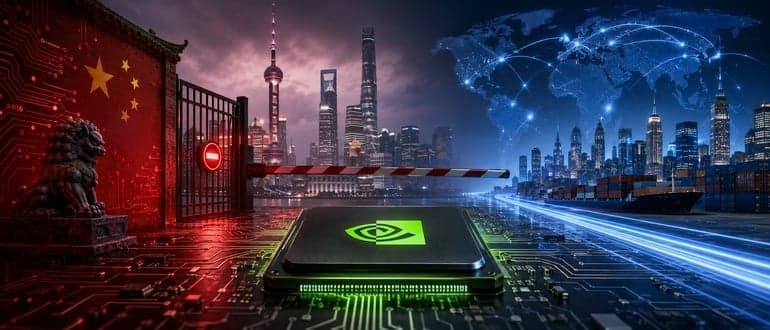
NVIDIA Corp. will cease selling its H200 artificial intelligence (AI) chips in China, acting CEO Colette Kress announced Tuesday, closing a controversial trade loophole just days after the departure of longtime CEO and co-founder Jensen Huang.
Speaking during NVIDIA’s first earnings call since Huang stepped down last week, Kress confirmed the company is exiting a pathway previously brokered by Huang and President Donald Trump.
That arrangement permitted NVIDIA to sell H200 accelerators to China by routing shipments through the United States to collect a 25% tariff. Alongside the sales halt, NVIDIA announced a new board-level committee dedicated to overseeing national security policies, export control compliance, and global trade risks.
The leadership transition and policy shift coincide with escalating regulatory pressure and federal investigations. Huang’s ouster, stemming in part from an affair with Alice Huang, the CEO of a company under investigation for smuggling restricted chips into China, came just before the U.S. government issued stringent new export rules on Monday.
The regulations bar advanced U.S. chips from foreign data centers that remotely serve Chinese clients, requiring large international facilities to certify they do not serve Chinese customers or risk losing access to NVIDIA hardware.
The regulations bar advanced U.S. chips from foreign data centers that remotely serve Chinese clients, requiring large international facilities to certify they do not serve Chinese customers or risk losing access to NVIDIA hardware.
Despite warnings from investment bank Jefferies that the new restrictions could trim between $44 billion and $62 billion from NVIDIA’s data center revenue next year, Kress downplayed the immediate financial risk. She said massive backlogs for newer architectures, such as Vera Rubin, ensure the rules will not impact top-line revenue.
However, analysts note long-term risks in Southeast Asia, where NVIDIA’s Singapore subsidiary alone generated $104 billion in 2025 before the company stopped disclosing regional figures.
Even before Tuesday’s announcement, Beijing had largely resisted H200 deliveries to bolster its domestic chipmakers, while Chinese AI labs bypassed restrictions by training models on prohibited NVIDIA Grace Blackwell chips at overseas data centers.
Complicating NVIDIA’s compliance landscape is a new report from The Information detailing how the chipmaker’s own sales team inadvertently aided an alleged smuggling network. According to the report, NVIDIA employees introduced Chinese tech giant Alibaba to Alice Huang twice in 2022, prior to major U.S. export bans. Securing Alibaba as a client allowed Huang to obtain bank loans to finance NVIDIA-equipped servers.
After Huang became a senior executive at Megaspeed, a Singapore-based cloud provider, the firm offered Chinese clients remote access to NVIDIA hardware via Southeast Asian data centers. Authorities allege that a network linked to Huang, including Megaspeed and Shanghai Century Litong, illegally moved billions of dollars’ worth of restricted NVIDIA hardware into China between 2023 and 2025.
On Monday, the U.S. Departments of Justice and Commerce confirmed that an investigation into Megaspeed’s export-control compliance began in 2024.
Federal authorities subpoenaed NVIDIA’s sales records in May 2025, prompting NVIDIA to place Megaspeed on its internal no-sell list the following month.
While the Justice Department continues its criminal probe, Megaspeed maintains it complies with applicable laws, and investigators have not accused NVIDIA or Alibaba of knowingly facilitating illegal chip shipments.