Hyperscaler earnings week has become an infrastructure spending competition. We compare capital budgets, count accelerators and discuss gigawatts as though the biggest number settles who is winning. Microsoft and Alphabet together reported $90.7 billion in cash additions to property and equipment for the quarter ended September 30. Those are company-wide investments, not exclusively AI spending, but they illustrate the scale of the commitment. What they cannot tell us is how much productive computing capacity those dollars will deliver. That requires looking inside the systems being built, where expensive processors can spend valuable time waiting for something else to happen.
My colleague Brendan Burke at Futurum recently put networking at the center of that discussion after speaking with Gilad Shainer, NVIDIA’s senior vice president of networking. Brendan’s argument deserves attention because the debate over GPUs and custom accelerators often treats the connections between them as a supporting detail. At large scale, those connections help determine whether the investment works. A processor can be extraordinarily fast on its own and still contribute to a system that performs well below expectations. Buying another rack does not automatically fix the reason the existing racks are waiting.
Consider what a distributed AI workload requires. Accelerators exchange information within a rack, across racks and sometimes between facilities, while also accessing storage and serving applications. During synchronized training, one delayed transfer can hold up work involving many processors. Congestion, uneven traffic distribution and recovery from failed links therefore become economic issues, not merely network administration problems. Maximum bandwidth tells us something about a connection’s potential. Buyers also need to know how predictably the system moves data when it is busy and what happens when a component fails.
The Cost of Waiting
Meta’s account of training Llama 3 provides a useful reality check. During a 54-day period, it recorded 419 unexpected interruptions, yet maintained more than 90% effective training time. Network switches and cables accounted for 8.4% of those interruptions; GPU-related problems were the largest category. The impressive accomplishment was keeping training productive through automation, diagnosis and recovery despite the failures. This was an operating challenge across the system, and it would be wrong to suggest a better network alone could have solved every problem. It would be equally wrong to judge the installation solely by how many GPUs it contained.
CoreWeave offers another way to see the difference between installed hardware and delivered performance. In its published DeepSeek-V3 MLPerf training benchmark, 2,048 GPUs completed the task in 5.54 minutes, while 8,192 GPUs finished in 2.02 minutes. Four times the hardware delivered approximately 2.74 times the speed. These were defined benchmark runs, not the original model’s entire training process compressed into minutes, and CoreWeave says they ran on customer-serving production infrastructure. The results demonstrate substantial scaling, while also showing that adding hardware does not yield a proportional reduction in completion time. They do not isolate networking as the cause of the gap.
There can still be excellent reasons to pay for that faster result. A research team may value completing an experiment sooner, and a service provider may need additional capacity to meet demand. But faster completion and lower cost are different outcomes, and buyers should know which one they are purchasing. Procurement comparisons that stop at accelerator prices miss the engineering required to turn those devices into a productive system. At these investment levels, the cost of waiting deserves as much scrutiny as the cost of buying.
NVIDIA is Selling the Integration
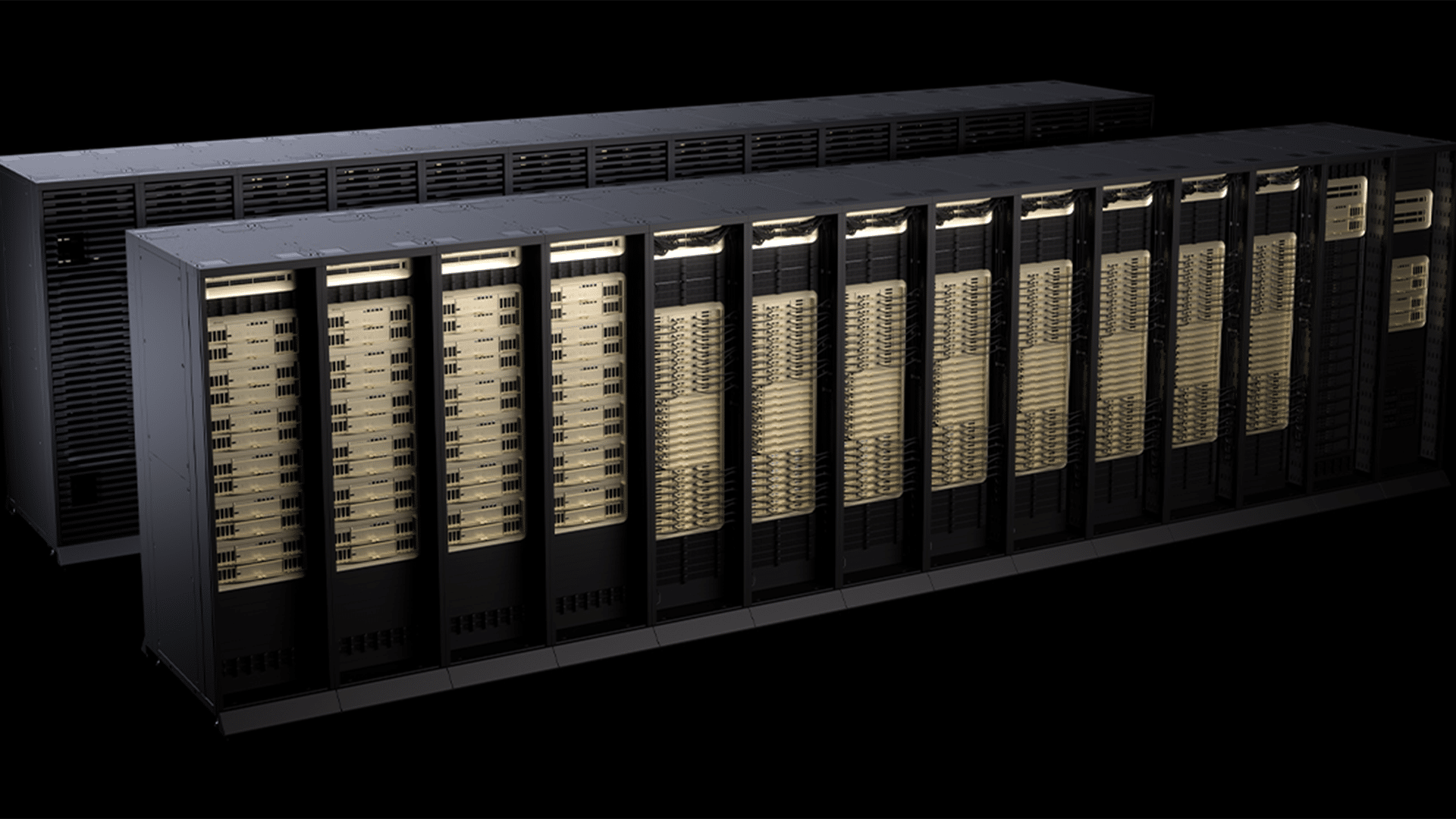
NVIDIA understands this relationship. Its offering reaches across accelerators, interconnects, switches, network adapters and the software that coordinates their work. The commercial value comes partly from engineering and validating those elements together, including their behavior under congestion and failure. For a customer, that can mean less integration work and a clearer path to diagnosing problems. I see that accumulated engineering experience as a more persuasive explanation of NVIDIA’s advantage than a checklist declaring that it covers five networks while someone else covers fewer.
The Spectrum-X research Brendan highlighted illustrates the point. NVIDIA reports a simulation in which training steps remained at 668 milliseconds with and without background traffic, while its conventional Ethernet baseline rose from 735 milliseconds to 1.18 seconds. That is meaningful evidence of isolation under the conditions tested. It is also vendor research against a specified Ethernet configuration, not a demonstration that every competing modern fabric suffers the same slowdown. The practical lesson is that a workload’s performance can depend heavily on what else shares the infrastructure. Predictability has value when customers are paying for service levels rather than laboratory peaks.
The optical discussion fits this broader systems view. Copper, pluggable optics and co-packaged optics address different combinations of distance, power, density and serviceability. NVIDIA’s participation with Cisco in developing USFP pluggables can coexist with its investment in co-packaged optics. USFP remains an announced development effort, and we should distinguish that from available products. Customers should evaluate the connection required for a particular job rather than interpret every form-factor announcement as a reversal of strategy. The economics depend on how the components work together in the intended deployment.
NVIDIA’s strategy becomes especially interesting when the accelerator belongs to somebody else. Through NVLink Fusion, companies can build custom silicon into infrastructure that uses NVIDIA interconnect technology and its broader ecosystem. d-Matrix plans to integrate its Raptor inference processors into NVIDIA MGX racks with NVLink, Spectrum-X and other NVIDIA components, with initial availability expected in the fourth quarter of 2027. That is a concrete commitment, although its production economics remain ahead of us. If it succeeds, a customer choosing a specialized accelerator could also become a larger customer for NVIDIA infrastructure.
AWS illustrates a more selective approach. Its planned Trainium4 integration with NVLink Fusion sits alongside AWS technologies including EFA networking and Nitro, with Trainium4 delivery expected to begin in 2027. Adopting NVIDIA at one layer does not require adopting it everywhere. These arrangements could become increasingly relevant as inference systems assign different stages of a request to different processors. Processing the prompt and generating the response place different demands on hardware, but specialization only pays when the cost of moving data between stages stays manageable. More accelerator choice can expand NVIDIA’s opportunity without guaranteeing it ownership of the whole system.
Make the System Prove Itself
There are credible alternatives to buying that integration from one supplier. Meta reported tuning its InfiniBand and Ethernet-based RoCE clusters to equivalent performance for its particular large-model workloads. OpenAI describes production networking built around its Multipath Reliable Connection protocol, developed with AMD, Broadcom, Intel, Microsoft and NVIDIA. These examples show what capable operators and their partners can accomplish. They also reveal the resources involved: the alternative to a deeply integrated platform may require substantial engineering of your own. Customers need to compare that work, its timetable and its operational risks alongside equipment prices.
For an enterprise buying cloud capacity, that scrutiny belongs in the service evaluation even if the provider owns the switches. Ask how long a training job takes, how much progress survives a failure and how inference behaves when neighboring workloads get busy. Compare costs at a specified response time and output quality, with power, support and engineering included where relevant. NVIDIA has a formidable position because it has spent years making these pieces work together, but its advantage should be demonstrated in the customer’s operating results. A purchase order records the accelerators acquired. The completed work reveals how much AI capacity the customer actually bought.