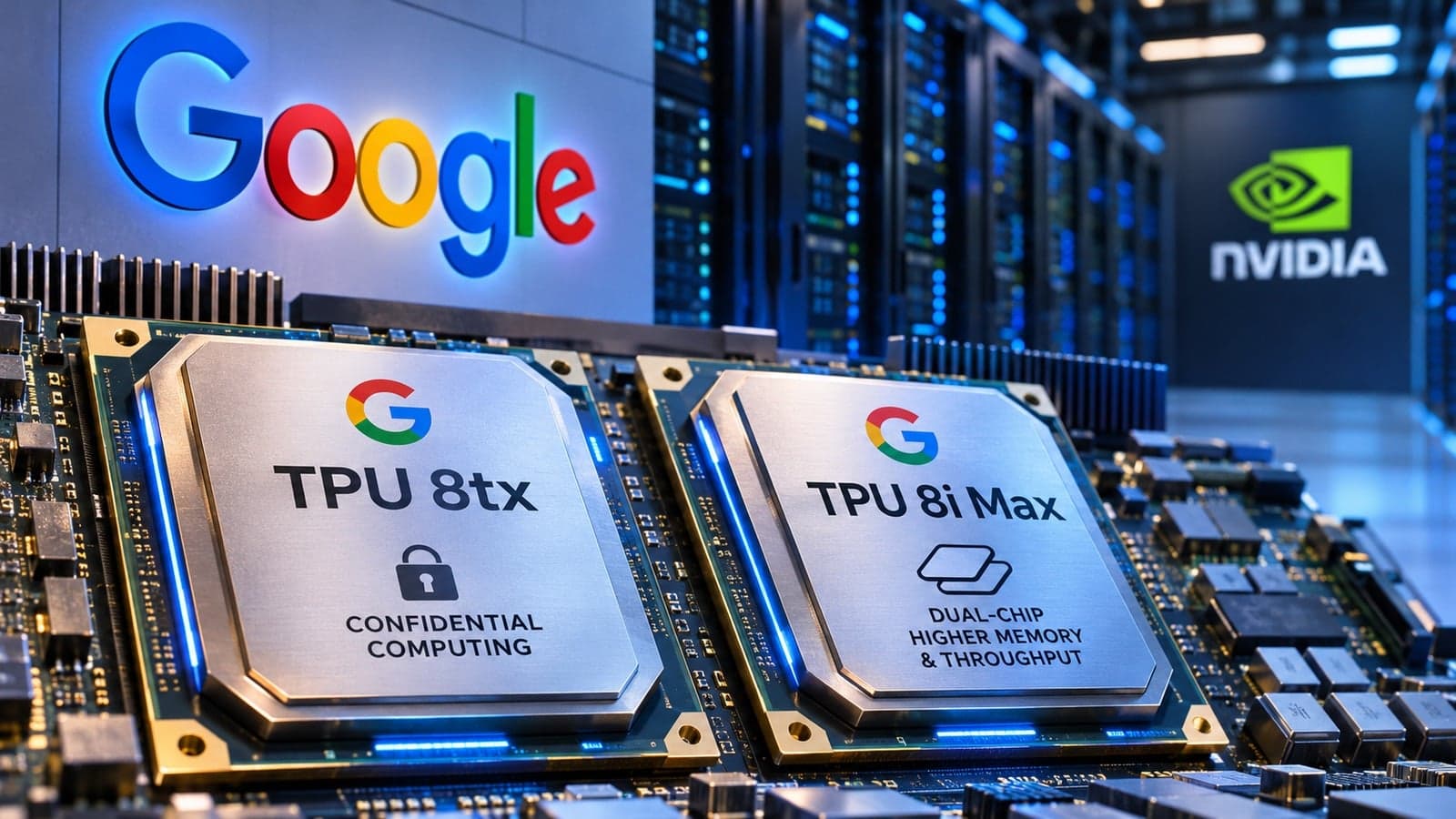
AMD has scored a big win over Intel, expanding its collaboration with Google Cloud that will see AMD’s fifth-generation EPYC server processors power the host systems for Google’s TPU 8tx AI accelerators.
The deployment is designed to enable confidential computing by protecting sensitive AI models, customer prompts, and other data while workloads are being processed in the cloud.
The collaboration addresses a growing challenge of protecting proprietary information while running computationally intensive inference, model fine-tuning and reinforcement-learning workloads.
Google’s TPU 8tx is the first Google Cloud Tensor Processing Unit (TPU) system to offer hardware-enforced confidential computing, according to the companies. The system combines Google’s eighth-generation TPU architecture with AMD’s EPYC processors and security technologies, extending protection beyond CPU-based computing environments to connected AI accelerators.
AMD brings its own special security systems to the table in the form of AMD Secure Encrypted Virtualization (SEV), part of the company’s security technology portfolio. SEV helps protect virtual-machine memory against unauthorized access. So the combined CPU and TPU architecture is designed to extend confidential computing safeguards to accelerator workloads.
The system can verify an accelerator’s identity and security configuration before allowing it to access protected memory. This approach is intended to help keep customer prompts, AI model weights and intermediate computation data encrypted in CPU memory and during transfers between the host processor and accelerators. Hardware isolation is also designed to protect workloads during execution.
The partnership builds on several generations of collaboration between AMD and Google Cloud. EPYC processors already support a range of Google Cloud Compute Engine virtual-machine families, including C4D, N4D, H4D, Z4D and G4. The companies have also worked together on security technology, including Google’s reviews of AMD security-processor firmware.
The announcement underscores the increasingly important role of server CPUs in AI data centers. Although GPUs and specialized AI accelerators do most of the heavy lifting around training and running AI models, CPUs are needed for preparing data, coordinating workloads, and managing communication between accelerators and the rest of the system, all tasks a GPU can’t do.
The deployment strengthens AMD’s position as a supplier of the general-purpose computing and security foundation beneath specialized AI hardware. As enterprises move from AI experimentation to production-scale reasoning and agent-based applications, the ability to combine accelerator performance with data protection may become an increasingly important differentiator for cloud infrastructure providers.