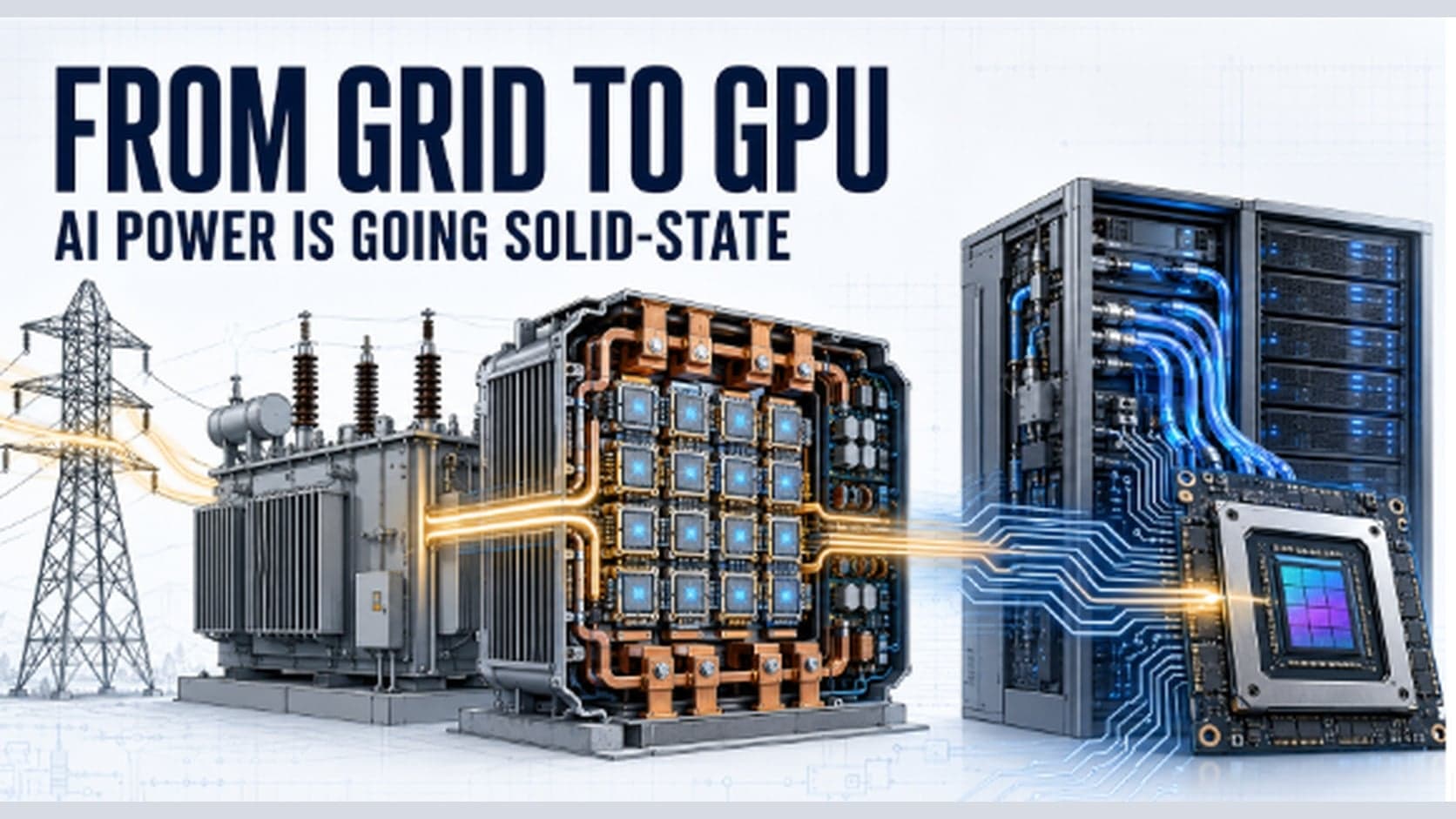
Analog Devices is expanding its role within the NVIDIA MGX ecosystem through the development of 800 VDC power technologies designed for next-generation AI factories. The announcement highlights how power delivery is becoming a critical component of AI infrastructure design as rack densities increase and future systems target megawatt-class scale. The development also reflects a broader shift in AI infrastructure, where efficiency, scalability, and power distribution increasingly influence deployment decisions.
What is Covered in This Article:
- Analog Devices outlined its work within the NVIDIA MGX ecosystem to support 800 VDC power delivery for future AI factories.
- NVIDIA’s MGX architecture is driving a shift from traditional 48V power architectures toward 800V rack-level designs.
- The transition supports higher rack densities, reduced power losses, and future megawatt-class AI infrastructure deployments.
- Analog Devices is developing high-voltage hot swap and DC-DC technologies focused on protection, telemetry, and power management.
- The announcement comes as Analog Devices expands its AI power portfolio through the planned acquisition of Empower Semiconductor.
The News: Analog Devices announced its continued collaboration within the NVIDIA MGX ecosystem to support the development of 800 VDC power architectures for next-generation AI factories. The company stated that increasing AI workloads and rising rack-level power density are driving a transition away from traditional 48V architectures toward higher-voltage designs capable of supporting future megawatt-class racks.
As part of this effort, Analog Devices (ADI) is developing high-voltage hot swap and DC-DC solutions designed to provide power protection, control, telemetry, and system monitoring capabilities. The company said these technologies will support modular MGX-based AI infrastructure where power delivery efficiency increasingly influences system scalability and deployment.
Can ADI Hot Swap Controllers De-Risk NVIDIA’s 800 VDC Transition?
Analyst Take: Scaling compute increasingly depends on scaling power delivery. ADI’s work within the NVIDIA MGX ecosystem focuses on the transition to 800 VDC architectures that can support future AI factories as rack power requirements continue to increase. NVIDIA has already identified traditional 48V/54V architectures as a limitation for future megawatt-scale deployments and has outlined plans to introduce 800 VDC infrastructure alongside Kyber rack-scale systems beginning in 2027.
Power Architecture Is Becoming A Core AI Infrastructure Layer
NVIDIA’s 800 VDC roadmap reflects a substantial change in how future AI factories may be designed. According to NVIDIA, traditional rack-level power architectures face increasing limitations as racks move beyond 200 kilowatts and ultimately target megawatt-scale deployments. The company outlined several challenges associated with legacy architectures, including space consumption from power shelves, increasing copper requirements, and inefficiencies created by multiple power conversion stages. Its proposed 800 VDC architecture aims to reduce power losses, improve efficiency, and simplify electrical infrastructure through centralized power conversion and higher-voltage distribution.
ADI’s’ announcement places the company’s power management technologies directly within a power architecture that NVIDIA views as necessary for future AI factory scale. The emphasis on power delivery efficiency also aligns with Futurum Group’s 1H 2026 Data Center Semiconductor Decision Maker Survey, which found that 35.2% of decision makers now identify tokens per watt as their primary AI infrastructure productivity benchmark, reflecting a growing focus on infrastructure efficiency rather than raw compute performance alone.
MGX Extends Modular Design Beyond Compute
The announcement also reinforces that NVIDIA MGX is evolving beyond a compute platform into a broader infrastructure framework. ADI highlighted that MGX’s modular approach increasingly separates power infrastructure from compute infrastructure, allowing system designers to optimize rack space and accelerate technology adoption. NVIDIA’s own discussion of future 800 VDC deployments similarly emphasizes centralized power conversion and row-level power distribution rather than traditional rack-centric approaches.
This modularity creates opportunities for ecosystem participants that provide critical infrastructure components rather than compute silicon itself. As AI infrastructure becomes more modular, power delivery systems increasingly become an independent layer of innovation rather than a fixed component inside the rack. The development suggests that future infrastructure differentiation may increasingly come from ecosystem-level design choices rather than individual hardware components.
Live Serviceability Creates New Technical Requirements
The shift toward always-on AI factories introduces operational requirements that differ from traditional data center environments. ADI specifically identified hot swap controllers as a critical technology for enabling the safe insertion and removal of server trays without interrupting operation. Operating at 800 VDC introduces additional challenges related to high-energy inrush current control, fault protection, and real-time telemetry.
These capabilities become increasingly important as rack densities rise and infrastructure operators seek to maximize system availability. NVIDIA’s broader 800 VDC initiative similarly emphasizes reliability and maintenance efficiency as key benefits of the transition. As a result, power protection and monitoring technologies may become as important to AI factory operations as the underlying compute platforms they support.
The Empower Acquisition Strengthens AI Power Delivery Exposure
The MGX announcement also aligns with ADI’s broader effort to expand its role in AI power infrastructure through its planned $1.5 billion acquisition of Empower Semiconductor. Both developments focus on the same challenge: delivering power efficiently as AI systems become denser and consume more energy. Empower’s integrated voltage regulator and silicon capacitor technologies are designed to improve power density, speed, and efficiency closer to the processor, while ADI’s MGX-related work focuses on power protection, telemetry, hot swap functionality, and high-voltage power delivery at the rack level.
Together, these efforts extend ADI’s reach across multiple layers of the AI power stack, from facility and rack-level infrastructure to processor-level power management. Rather than treating power delivery as a supporting function, ADI increasingly appears to be positioning it as a core element of next-generation AI system design.
What to Watch:
- NVIDIA expects 800 VDC infrastructure to coincide with Kyber rack-scale systems beginning in 2027, making ecosystem readiness an important milestone for adoption.
- NVIDIA estimates that 800 VDC architectures can improve end-to-end power efficiency by up to 5%, reduce copper requirements, and support racks ranging from 100 kW to more than 1 MW using the same infrastructure.
- ADI’s’ ability to commercialize high-voltage hot swap, telemetry, and DC-DC technologies will determine how deeply it participates in future MGX deployments.
- The planned acquisition of Empower Semiconductor provides additional AI-focused power delivery technologies that could expand ADI’s role across future AI infrastructure designs.
- NVIDIA and ecosystem partners continue to evaluate safety, operational, and deployment considerations associated with facility-level 800 VDC architectures, making execution an important factor in broader adoption.
See the complete announcement on powering the next generation of NVIDIA AI factories with MGX on the Analog Devices website.
Declaration of generative AI and AI-assisted technologies in the writing process: This content has been generated with the support of artificial intelligence technologies. Due to the fast pace of content creation and the continuous evolution of data and information, The Futurum Group and its analysts strive to ensure the accuracy and factual integrity of the information presented. However, the opinions and interpretations expressed in this content reflect those of the individual author/analyst. The Futurum Group makes no guarantees regarding the completeness, accuracy, or reliability of any information contained herein. Readers are encouraged to verify facts independently and consult relevant sources for further clarification.
Disclosure: Futurum is a research and advisory firm that engages or has engaged in research, analysis, and advisory services with many technology companies, including those mentioned in this article. The author does not hold any equity positions with any company mentioned in this article.
Analysis and opinions expressed herein are specific to the analyst individually and data and other information that might have been provided for validation, not those of Futurum as a whole.
Other Insights From Futurum:
Analog Devices Q2 FY 2026 Earnings Show AI-Linked Data Center, Power Demand
Will Analog Devices’ Empower Deal Reshape Power Delivery for AI Data Centers?
Texas Instruments Buys Silicon Labs To Fuel Edge AI Scale
Originally published by Futurum Group. Republished with attribution.