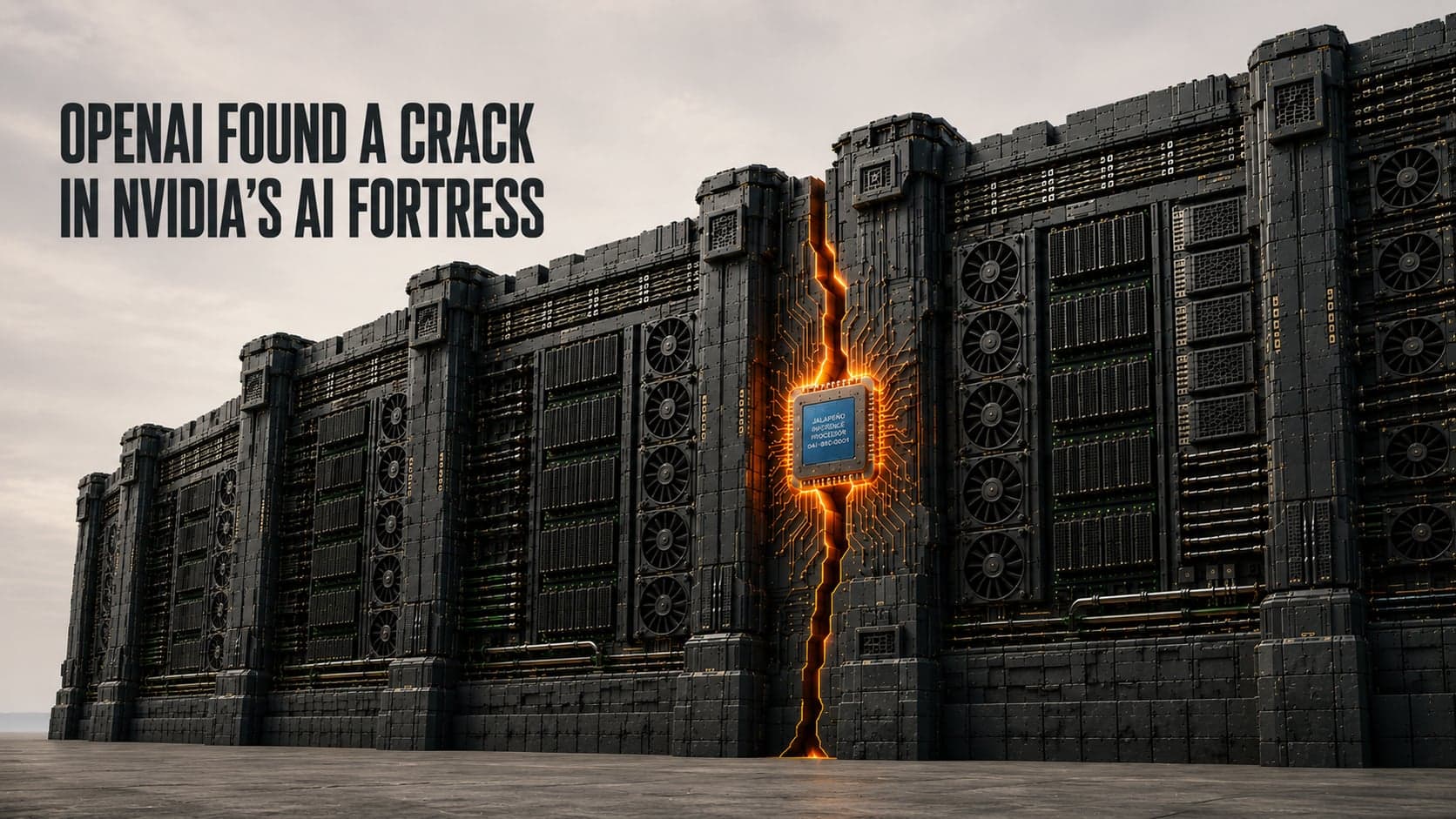
Chinese startup DeepSeek is reportedly developing its own AI inference chip, a move that would lessen its reliance on processors from NVIDIA and Huawei and place it on a growing list of AI developers building proprietary silicon.
The planned processor is intended for inference, when an AI model produces responses to user prompts. That segment of AI computing has become the industry’s fastest-growing market as enterprises shift from building models to deploying them in production.
The project remains in its early stages. DeepSeek has reportedly begun discussions with chip designers, semiconductor foundries and memory suppliers while quietly expanding its engineering team with semiconductor specialists. The company has not publicly commented on the reported effort.
The new chip would be a major evolution for a company that has been known primarily for software. DeepSeek attracted worldwide attention in January 2025 after releasing AI models that demonstrated competitive performance while using substantially fewer computing resources than many Western rivals. (Though the exact resources the company used have always been a matter of debate.)
Those releases prompted concern over US AI infrastructure spending and briefly pressured NVIDIA’s and the overall tech sector’s market value as investors questioned future demand for premium GPUs.
Trend Toward Developing Custom Silicon
Developing custom silicon would also place DeepSeek alongside several leading AI companies seeking greater control over their AI stack. OpenAI recently debuted its first inference chip developed with Broadcom, while Anthropic has also explored designing proprietary processors. Owning both the model and the hardware allows AI developers to reduce operating costs and lessen dependence on third-party chip suppliers.
For DeepSeek, the strategy also impacts the US vs. China AI competition. US export restrictions continue to limit Chinese access to NVIDIA’s most advanced AI chips, encouraging domestic companies to develop alternatives. DeepSeek has previously relied on both NVIDIA and Huawei hardware. The company has said its R1 reasoning model was trained using NVIDIA’s H800 processor, a version designed specifically for the Chinese market before US authorities later prohibited its export.
More recently, DeepSeek has increased its use of Huawei technology. DeepSeek’s V4 model was adapted for Huawei’s Ascend platform, and Huawei’s Ascend processors were used for portions of the training behind V4-Flash. Demand for Huawei’s Ascend 950 chips reportedly increased after those releases, a sign of China’s accelerating shift toward domestically developed AI infrastructure.
DeepSeek has been fundraising. After years of avoiding outside investment, the company was recently reported to be preparing its first external fundraising round, targeting approximately $7 billion at a valuation estimated that may go as high as $59 billion.
This extra investment will be needed: building advanced semiconductors requires billions of dollars and years of engineering work. Chinese chip developers also face restrictions on advanced overseas fabrication as well as limits on obtaining high-bandwidth memory, a key component for AI systems that has seen major price increases.