For most of computing history, progress meant separating the software from the machine.
Software could be changed, upgraded and replaced without throwing away the computer beneath it. Hardware became increasingly general purpose, while software developers gained the freedom to decide what those machines would do. The decoupling of hardware and software helped create the modern technology industry.
Now Google may be preparing to run that history in reverse.
According to reporting by The Information, Google is developing an experimental server chip, informally called Frozen v2, that would incorporate parts of the architecture of its Gemini artificial intelligence models directly into the silicon. Google engineers reportedly believe the chip could produce six to ten times as many tokens per unit of power as the company’s latest tensor processing units, or TPUs. Deployment could begin as early as 2028, although this remains an internal project, not an announced commercial product.
If it works, the future of AI infrastructure may look surprisingly similar to the custom-ASIC past. Instead of building chips capable of running almost any model, Google would build a chip designed around the recurring computational patterns of Gemini.
What’s old is new again. Except this time, the application being turned into hardware may be the intelligence itself.
There is an important distinction here. Frozen v2 would not necessarily be a completed Gemini model permanently sealed inside a chip.
Google reportedly considered an earlier and even more radical approach that would have embedded Gemini’s model weights—the learned parameters containing what the model knows—directly into the hardware. That design would have been extraordinarily efficient, but also extraordinarily inflexible. Every meaningful update to Gemini could have required a new generation of silicon.
The company apparently abandoned that version. Frozen v2 instead would hardwire parts of Gemini’s underlying architecture while leaving the weights reloadable.
Think of it as one model family per chip rather than one immutable model per chip.
Google could retrain Gemini, fine-tune it, update its knowledge and adjust its behavior without necessarily replacing the hardware. But those updates would have to remain compatible with the architecture physically embodied in the chip. A fundamental change to Gemini’s layer structure, attention mechanisms, mixture-of-experts design or some other foundational element could render parts of that silicon obsolete.
That is both the opportunity and the danger.
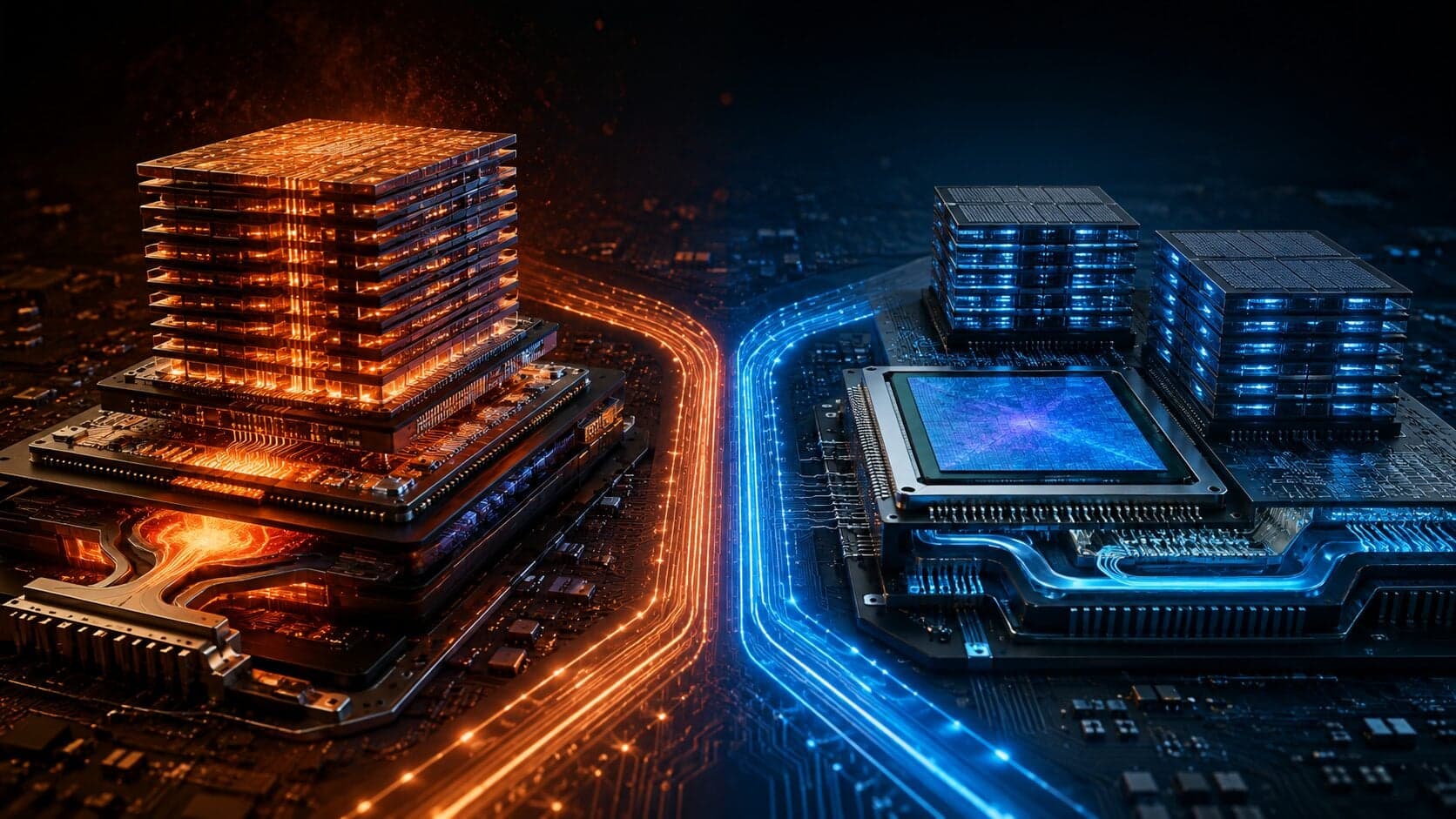
The progression from general-purpose processors to Frozen v2 reflects a familiar pattern. CPUs can perform many kinds of computation. GPUs are more specialized, but remain programmable enough to train and run a wide range of AI models. Google’s TPUs go further by optimizing hardware around the matrix operations used in machine learning while still supporting different models and architectures.
Frozen v2 would take the next step. It would remove more of that flexibility and implement some of Gemini’s recurring operations directly in circuitry.
Programmability is powerful, but it is not free. General-purpose chips include capabilities that any one workload may never use. They spend energy moving data, interpreting instructions and coordinating operations that could be handled more directly if the hardware already knew what the software was going to ask it to do.
Frozen v2 would know.
This is the basic logic behind an application-specific integrated circuit, or ASIC. When a workload becomes predictable, valuable and large enough, it can become economically attractive to turn software instructions into specialized hardware.
We have seen this movie before. Networking functions moved from software into purpose-built chips. Video encoding gained dedicated hardware. Encryption became embedded in processors. Bitcoin mining moved from CPUs to GPUs and ultimately to ASICs engineered to do little besides calculate the particular hashes required by the Bitcoin protocol.
Each transition involved the same bargain: Give up flexibility in exchange for speed and efficiency.
During experimentation, flexibility is invaluable. At sufficient scale, it becomes expensive overhead.
Google appears to be asking whether AI inference has crossed that threshold.
The economics explain why it might. Training frontier models attracts much of the attention, but inference is where the meter keeps running. Every Gemini query, AI-generated search result, Workspace summary, coding suggestion and Android interaction consumes processing power. Multiply that by hundreds of millions of users and billions—or eventually trillions—of requests, and even modest efficiency improvements become enormously valuable.
A six-to-ten-times improvement in tokens per watt, if Google can actually achieve it in production and across meaningful workloads, would be anything but modest. It could allow Google to generate more AI output from its existing data centers, lower the marginal cost of Gemini, improve response times and reduce the amount of new power and infrastructure required to satisfy demand.
That last point should not be underestimated. The AI industry’s constraint is no longer simply access to the best chips. It is access to enough electricity, cooling, land, networking capacity and capital to operate them. Every token Google can generate without building another data center becomes increasingly valuable.
But Google would be making an extraordinary wager: That Gemini’s architecture will remain useful for at least as long as it takes to design, manufacture, deploy and amortize the chips built around it.
Software can change overnight. Silicon cannot.
This introduces a new category of technical debt. Call it silicon debt.
Traditional software debt accumulates when companies build systems that become difficult to maintain or adapt. It can be expensive and disruptive, but software can ultimately be patched, refactored or rewritten.
A data center filled with chips designed around yesterday’s AI architecture cannot be patched into a fundamentally different machine. If a competing architectural breakthrough makes today’s transformer designs obsolete, Google could find itself operating billions of dollars of highly efficient hardware optimized for the wrong kind of intelligence.
Frozen v2 could then become an expensive monument to a moment that passed before the chip reached scale.
The semiconductor timetable makes that danger real. A model architecture can evolve several times during the years required to design and manufacture advanced silicon. Google would have to decide which elements of Gemini are stable enough to freeze long before it knows what the competitive frontier will look like in 2028 or 2029.
That is why Frozen v2 is more than a chip experiment. It is a statement about Google’s view of AI development.
The project’s existence does not prove that frontier AI architectures are stabilizing. It suggests Google believes they may be stabilizing enough to manufacture.
If Google is right, using programmable GPUs for every large-scale inference workload could eventually look wasteful. Why repeatedly instruct a flexible processor to perform the same sequence of operations when those operations can be made part of the machine?
If Google is wrong, the flexibility it eliminated will suddenly look priceless.
This does not mean GPUs or TPUs are going away. A more likely outcome is a division of labor across the AI infrastructure stack.
Flexible chips will continue to train new models, support experimentation and accommodate outside architectures. They will be essential anywhere the workload is still changing, or the operator does not control the model. TPUs will continue to provide Google with a programmable AI platform capable of serving a broad range of training and inference requirements.
Frozen chips would be deployed against the enormous, repetitive and relatively stable inference workloads Google understands best.
Flexible silicon invents the next model. Frozen silicon cheaply serves the current one.
The economics of that approach probably work only at hyperscale. Designing and manufacturing an advanced custom processor is too expensive to justify for a model with a modest number of users. Google, however, can spread that cost across Search, Gemini, Workspace, Android, Google Cloud and nearly every other corner of its business.
Google also occupies a position few AI companies can match. It controls the model, the weights, the architecture, the compiler, the chip design, the data centers, the applications and much of the distribution.
Frozen v2 would make that vertical integration physical.
Gemini would no longer merely run on Google’s infrastructure. Its architectural assumptions would be embodied in that infrastructure. The model and the machine would become parts of the same engineered system.
That could give Google a significant advantage over independent model companies. An AI laboratory renting GPUs from someone else must pay for the flexibility of those processors whether it needs all of it or not. Google could optimize its hardware and software together, lowering costs in ways that may be impossible for competitors without their own silicon programs and enormous captive workloads.
This is where the competition with Nvidia becomes more nuanced.
Nvidia’s strength is not simply that it makes powerful GPUs. It has built the programmable platform on which much of the AI industry can experiment, train and deploy. Its flexibility is the point. Nvidia does not have to know which model architecture will win because its customers can use its hardware to build almost any of them.
Google is making a different bet. It does not need to support every possible model on every chip if it can predict which workloads its own services will run at vast scale.
Nvidia is selling optionality to the AI industry. Google may be deciding that, for its most stable workloads, it no longer wants to pay for it.
That decision could also deepen lock-in. A chip designed around Gemini is unlikely to be equally useful for Claude, GPT, Kimi or whatever new architecture emerges next. Google Cloud customers using Gemini might receive compelling performance and pricing, but those advantages could bind them more tightly to Google’s entire stack.
The same vertical integration that creates efficiency for Google can reduce choice for its customers.
Frozen v2 therefore raises a larger question about where durable advantage will reside in AI. Will the winners be the companies with the most capable models? Or will they be the companies capable of turning those models into the most efficient machines?
The answer is probably both. Model performance without affordable inference may prove commercially unsustainable. Efficient infrastructure serving an inferior model will not be enough either. The strongest position may belong to companies that can repeatedly coordinate both sides: develop competitive models, identify which parts are becoming stable, freeze those parts into silicon and then update the entire system before it falls behind.
That would turn model development and chip development into a single product cycle.
It would also make the price of a wrong architectural decision far higher. A weak software release can be replaced. A weak silicon generation occupies racks, consumes power and ties up capital for years.
Google deserves credit for being willing to explore the trade-off, but Frozen v2 should not yet be mistaken for a proven breakthrough. The reported six-to-ten-times efficiency improvement is an engineering projection. Real-world performance will depend on context length, batching, latency requirements, memory systems, utilization and the particular Gemini workloads being measured. Chip-level gains do not always translate cleanly into equivalent data-center savings.
There is also a great distance between an experimental design and a reliable processor manufactured at scale. Google still has to navigate fabrication, packaging, memory, networking, software compatibility and the possibility that Gemini itself changes before Frozen v2 is ready.
Yet even if Frozen v2 never reaches broad production, the thinking behind it matters.
The AI industry has spent the past several years pursuing bigger clusters of programmable accelerators. Google is considering whether the next efficiency breakthrough comes not merely from a faster chip, but from collapsing the distance between the model and the processor.
For decades, software escaped the machine. It became portable, changeable and largely independent of the hardware beneath it. That separation produced an extraordinary wave of innovation.
AI may now be so valuable, repetitive and power-hungry that it begins pulling software back into silicon.
What’s old is new again. But this time, the ASIC may not simply accelerate an application. It may represent the moment the model becomes the machine.