Rackspace Technology and AMD have signed a memorandum of understanding outlining a collaboration focused on building AI infrastructure for regulated industries for which data residency and compliance are essential requirements.
The proposed partnership combines AMD’s Instinct GPUs, EPYC CPUs and ROCm software ecosystem with Rackspace’s managed infrastructure services. Rather than selling enterprises raw GPU capacity, the companies intend to offer managed AI infrastructure in which Rackspace operates and oversees the full stack.
While many organizations have deployed or experimented with LLMs and AI applications over the last two years, regulated sectors have advanced more slowly due to concerns around governance, uptime guarantees, auditability and control over where data is processed.
The AMD-Rackspace partnership is an attempt to gain market share among these regulated sectors. The companies are positioning the offering as an alternative to the dominant cloud AI consumption model in which enterprises rent GPU resources from hyperscale cloud providers and manage governance independently.
Several Core Offerings
Under the framework outlined by the companies, the collaboration would support an array of key offerings.
The first is an Enterprise AI Cloud platform built around private and hybrid AI deployments. The platform will use AMD Instinct accelerators and EPYC processors inside environments managed by Rackspace. The companies said the offering is intended for organizations that require strict controls over sovereignty and compliance.
Another key component, the Enterprise Inference Engine, offers a managed runtime environment for AI inference workloads. Rackspace said the system would retain contextual enterprise data, session history and domain-specific information across AI queries, allowing AI agents and LLMs to operate with persistent company knowledge.
The companies also outlined an Inference as a Service feature that provides dedicated AI compute without relying on public GPU rental models. Customers can bring their own AI models and orchestration frameworks while Rackspace manages the hardware, including service-level objectives and operational support.
An additional offering would provide bare-metal AMD Instinct infrastructure for organizations requiring direct hardware access, deterministic performance or isolated environments for specialized training and inference tasks.
Distributed Between CPUs and GPUs
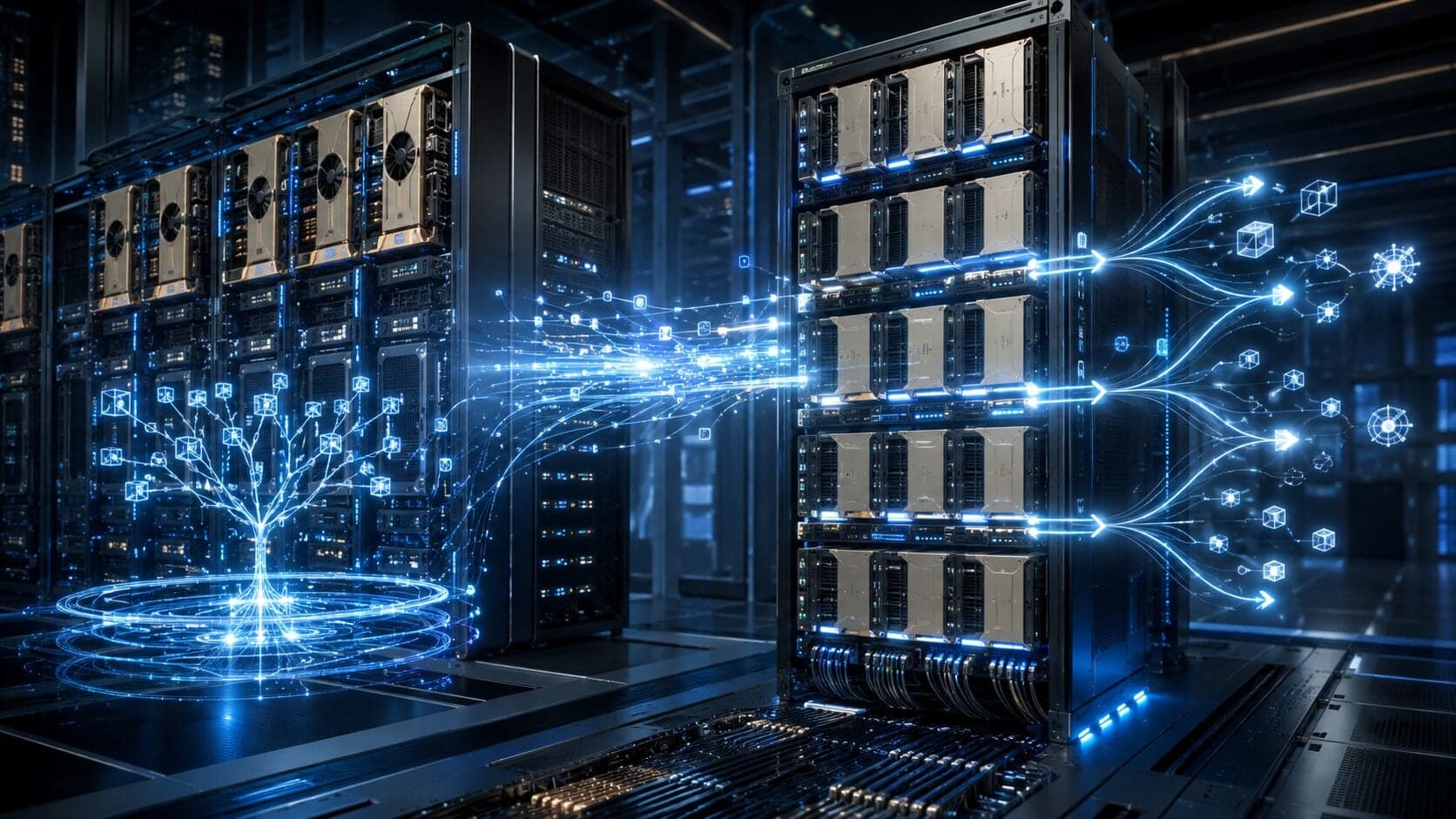
The combined architecture emphasizes heterogeneous computing, where workloads are distributed between CPUs and GPUs depending on performance and cost requirements. Many enterprise AI tasks, such as retrieval systems, embeddings, machine learning and smaller language models, run efficiently on CPUs rather than pricey GPU infrastructure.
The partnership expands Rackspace’s enterprise AI ecosystem. The company said its AI stack already incorporates VMware Cloud Foundation 9 as a control plane for managing compute, networking, storage and security across hybrid and sovereign environments. The stack also integrates Palantir software for governed data and AI operations and Uniphore technology for agent-based workflows.
The demand for sovereign AI infrastructure is rising globally, a factor that likely prompted the AMD-Rackspace partnership. Enterprises are increasingly evaluating workload placement, long-term infrastructure costs and compliance requirements alongside model performance.
SHARE THIS STORY
Originally published by Techstrong.IT. Republished with attribution.